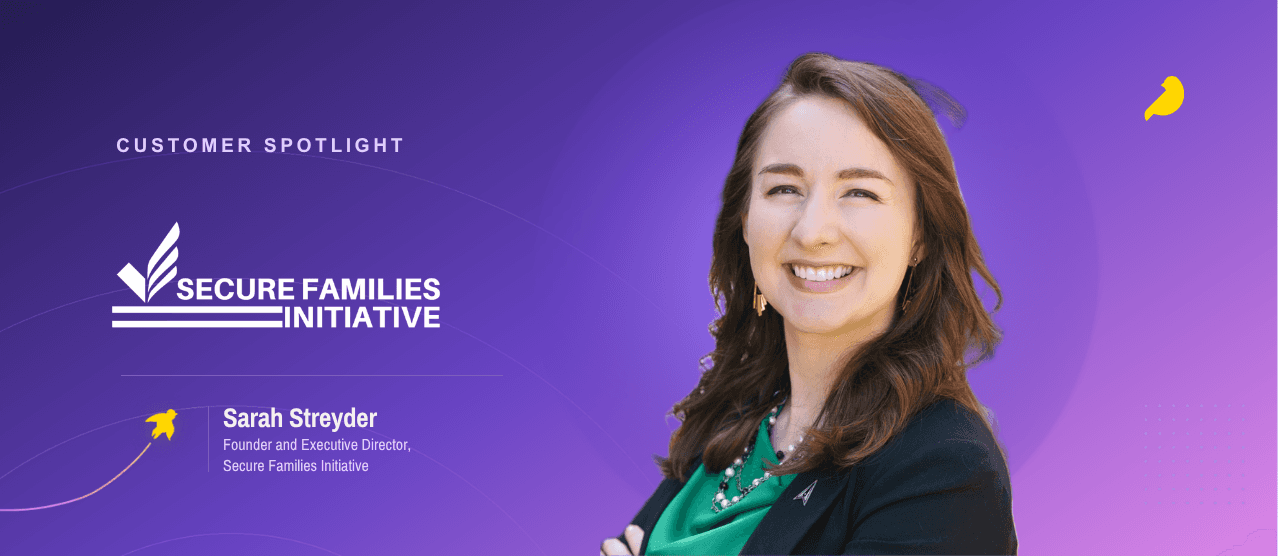
Building the Seat at the Table For Military Families: How Secure Families Initiative Protects the People Speaking Up
SFI’s founder and executive director explains why military-connected families face a distinct set of online risks, and how Kanary helps her organization ask staff to speak publicly without asking them to carry that risk alone.

Sarah Streyder, Founder and Executive Director, Secure Families Initiative
Sarah Streyder started Secure Families Initiative (SFI) in 2020, but the idea took root years earlier, in the space between a phone that wouldn't ring and a news alert she couldn't stop reading. As the spouse of an active duty service member, she spent a deployment cycle sorting through fear and uncertainty largely on her own. Then, working as a campaign manager, she watched voter registration data shape decisions that went far beyond any single election, and she noticed a persistent gap in civic participation between military families and their civilian neighbors.
Those two experiences convinced her that military families needed an organizing home of their own, one built to turn private frustration into public voice. Today SFI is a nonpartisan organization that mobilizes military-connected loved ones around three issue areas: voting rights, foreign policy, and civil rights. The organization coaches individual families through the voting process, brings them into rooms where they can share their stories to policymakers, and works to close civil rights gaps that fall through the cracks between federal and state jurisdiction.
That public-facing work comes with a cost that most people never think about. Military families are trained to think about operational security by necessity, and speaking out on policy adds a layer of exposure that few advocacy organizations have to consider. In this Q&A, Sarah talks about why she built SFI, the specific risks her community faces online, and how Kanary lets her ask staff to be visible without asking them to absorb that risk alone.
Why Sarah started Secure Families Initiative
What drew you to build this organization?
I founded SFI because of my own experience. I'm the spouse of an active duty service member, and we've been in this life for over a decade now. Back in 2018, my service member deployed for the first time, and I felt firsthand how lonely and isolating it is to have someone you love out there in harm's way. When news comes down, you're left to sort through it alone, wondering if it's something that could be affecting your family, and feeling voiceless about decisions being made far above your head.
Around the same time, I was working as a campaign manager, and I saw how voter registration rates and turnout shaped a lot more than the numeric outcome of an election. They shaped who ran, how they ran, and how they governed once they got there. There has always been a participation gap between military families and our civilian counterparts, and I wanted to close it. In 2020, I launched SFI to give military families a place to organize as voters, get coaching through a process that isn't built for people who move every few years, and bring their stories to policymakers who rarely hear from them directly.
"People assume that because you're part of a military family, you must love war. The opposite is true. I want our foreign policy to exhaust every alternative before it puts my children's father in harm's way. But we don't often have a seat at the table where those decisions get made, and it takes real work to build the power to demand one."
How has the organization grown since then?
We started by focusing on voting access and foreign policy, and we added a civil rights portfolio as we heard more from families about the gaps in their legal protections. A lot of that stems from how military families relate to federal versus state and local jurisdictions. Because our community moves so often, we fall through some cracks that a more geographically stable population wouldn't. Those three areas - voting rights, foreign policy, and civil rights - are where nonpartisan consensus is easiest to find and, at the same time, where disagreement runs deepest. Anyone connected to someone in uniform carries a heightened sense of risk around speaking up on any of it.
Why safety became part of the mission
Where does that heightened risk come from?
Military spouses already worry about the internal, social version of this. Something like, “will writing an op-ed critical of a policy affect my service member's next promotion?” We've done a lot of work to break that concern down. But there's an added layer when you're connected to the national security apparatus. You become a target for foreign adversaries in a very real, very current way. I'm not an employee of the Defense Department. I've never signed anything. I'm just married to someone who has. And yet I've still been trained on operational security and personal security basics, because the department knows there are people out there who wish us harm and want to keep military families as safe as possible.
So when we ask our staff to be increasingly public facing as part of the work, we recognize the risk we're asking them to take on. Protecting some of their personal information on the back end is our way of “covering their six,” to use the military term, while we ask them to speak up.
Can you share an example of what that risk actually looks like?
Sometimes we are coached not to use our real names on social media, because our accounts often contain some reference to a service member’s family member somewhere. Bad actors scan for exactly that kind of detail, then use geographic tagging and other data to build a fuller picture. It's the kind of generic online safety awareness a lot of parents are starting to develop, but layer on top of that the fact that specific threat actors are actively looking for military-connected details. The moment anything military related shows up, you're under a different level of scrutiny.
I think about the families who've been counting down the days until a service member gets home after a months-long deployment, who can't tell their own parents or in-laws any of the specifics of when or where, because missions have been canceled over someone accidentally texting the wrong person or posting in the wrong Facebook group. I don't want to worry monger, but I do want civilian counterparts to understand how much this service costs families in ways that rarely get talked about.
Why Kanary is part of that strategy
What has your experience with Kanary been like day to day?
Honestly, the tool requires very little from me, and that's exactly the point. I barely have to think about it, and I mean that as a compliment. Every once in a while I get a notification that there's something to review, and it's almost like a time capsule. Old Facebook information from thirteen years ago, an address tied to a sibling, that kind of thing. I don't have a ton of detailed interface feedback, and in my case that's a good thing.
“Kanary provides peace of mind, and allows me to feel safe while carrying out our mission."
Has that peace of mind changed as your circumstances have changed?
It has. When I was living overseas for three years, most of the data connected to me was stateside information without a direct physical tie to where I was actually sleeping at night. Now that we're back in the States, that same information sits a lot closer to home. Knowing that Kanary is continuously working in the background matters more to me now than it did before, precisely because the distance that used to buffer some of that risk isn't there anymore.

What would you tell other organizations thinking about digital safety for their staff?
Whether or not military-connected families make up the core of your community, chances are someone on your staff or in your volunteer base is one. If it matters to your organization to convey military friendliness or fluency, this is a meaningful way to show it.
“Plenty of companies build affinity groups for military spouses and veterans among their employees, and offering something like Kanary is a concrete gesture in that same direction.”
Even if you can only extend it to some of your team, asking who among your staff or volunteers has that connection and offering this kind of protection sends a real signal that you understand the added risk your work is asking them to carry.
Secure Families Initiative is a nonpartisan organizing home for military-connected loved ones working to advance voting rights, foreign policy, and civil rights protections for the military family community. Learn more at https://securefamiliesinitiative.org/.
