
The Blast Radius: What Happens to an Organization When Someone Connected to It Gets Doxxed
Recently, Carnegie Mellon University found itself issuing statement after statement about an associate professor whose personal social media posts, unrelated to her research or teaching, had drawn national attention. The university opened a review, placed her on leave, and spent the better part of a news cycle managing a controversy that had nothing to do with campus operations.
The university got pulled into that fallout the moment the professor's name and job title started circulating online, framed as a scandal. That's the pattern: organizations get dragged into risk that started well outside their walls, and most don't see it coming until it's already showing up as a flood of calls to the front desk.
These campaigns are coordinated, not random
The wave of doxxing that followed Charlie Kirk's assassination in 2025 didn't just target people. It targeted the organizations connected to those people. NPR reported that one high-profile influencer published explicit instructions for identifying a target's workplace, then calling that workplace and leaving Google reviews. A site called Expose Charlie's Murderers compiled names, locations, and workplaces into what organizers described as a planned database of more than 20,000 entries.
That campaign targeted organizations, not just individuals. A teacher's post becomes a school district's phone problem. A biologist's repost becomes a state wildlife agency's phone problem. NPR's reporting on the fallout noted this created "significant liability concerns for human resources departments managing rapid-response investigations," because those departments had to make personnel decisions in public, in real time, based on call volume rather than facts.
The internet mob doesn't wait for facts before causing harm
The same mechanism reaches organizations that never received a single legitimate complaint. The FBI questioned Zach Qureshi, a 25-year-old bystander who'd been standing near Charlie Kirk when he was shot, and released him within hours. Investigators found no evidence connecting him to the crime. His family's home address still circulated across social media before he made it home. His mother asked local reporters to withhold their location.
That story never named an organization. But it's the same mechanism that reaches organizations every day: a person's name surfaces in a fast-moving story, and whoever is reachable around them (an employer, a landlord, a professional license board, a spouse's workplace) becomes a pressure point before anyone has confirmed a single fact.
The fast-moving, unpredictable nature of how viral or controversial events unfold creates an attack chain and blast radius the entangles the targeted individual, their inner circle and the organizations they are associated with.
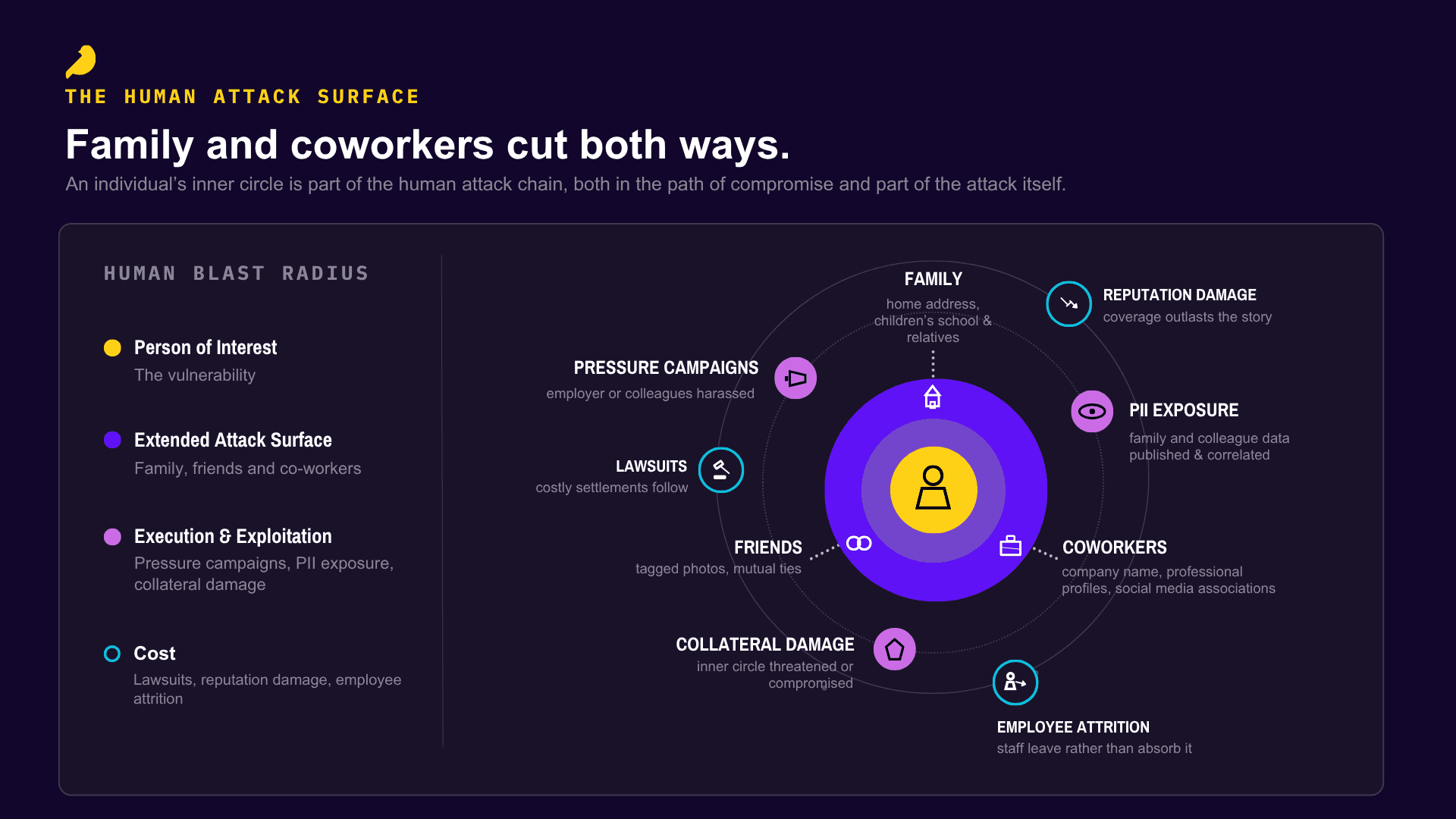
Acting fast created a second, larger risk
The organizations that moved quickest to fire an employee under public pressure in an attempt to distance themselves didn't come out ahead. NPR later tracked at least five public employers that settled First Amendment retaliation lawsuits after terminating employees over Kirk-related posts: the Iowa Office of the State Public Defender paid $125,000, Creston Community School District paid $145,000 plus full benefits, Ball State University paid $225,000, the Florida Fish and Wildlife Conservation Commission paid $485,000, and Austin Peay State University paid $500,000 and reinstated the professor it had fired. Combined, that's close to $1.5 million in settlements alone, before legal fees.
The lesson isn't that organizations should ignore a controversy involving an employee. It's that they should be addressing the risks as part of their security and operational planning.
What this means for an organization's own exposure
A few things distinguish the organizations that handled this well from the ones that ended up writing settlement checks.
A documented, pre-built response process. In nearly every settled case, the employer decided to fire someone within about five days of a call campaign and never documented a real workplace disruption. Building that response plan calmly, before a crisis hits, closes that exact gap. It should name who verifies complaints, who speaks publicly, and what threshold triggers a personnel action.
Visibility into which employees carry public exposure. Executives, faculty, public-facing staff, and anyone with an online presence connected to their role sit one reverse-image search away from becoming the organization's next incident. Knowing who those people are, and how findable their employer, address, and contact information already are, is the difference between preparing for this and reacting to it.
Ongoing monitoring, not a one-time check. Once an organization knows which people carry the most risk, that picture needs to stay current. A one-time audit goes stale within weeks; a tool built to continuously track and reduce that exposure doesn't.
A plan for the people around the person, not just the person. Mannarino's instructions were explicit about routing pressure through the employer. That playbook doesn't distinguish between an employee, a family member of an employee, or an affiliated volunteer. Any organization connected to someone who becomes the center of a story should assume it's a named target too, not an innocent bystander.
This is why Kanary works with security and operational teams before a crisis starts. We map which employees, executives, and affiliates already have findable home addresses, family details, or employer information sitting out in the open, then close that exposure before an organized campaign ever finds it.
Worried about how doxxing can impact your organization? Let's chat.
